
👆 Key Takeaways
- In small intestinal bacterial overgrowth (SIBO), too many bacteria have colonized the small intestine. They begin converting sugar and other carbohydrates into gases at an unusually early stage of digestion, which often causes bloating, abdominal pain, and changes in bowel movements. 1
- A central goal of nutritional therapy for SIBO is to provide less “food” for the bacteria. Certain carbohydrates (FODMAPs) and free sugars are therefore significantly restricted to help reduce symptoms. 2,3
- Fructose, table sugar, lactose, and certain sugar alcohols such as sorbitol and xylitol can be particularly problematic. Glucose and dextrose, on the other hand, are usually absorbed more quickly and are often better tolerated in small amounts. 2,3
- SIBO-friendly sweeteners may include dextrose, rice syrup, and maltodextrin. Erythritol and stevia are also discussed as possible alternatives. It is worth testing them cautiously to see what your own digestive system tolerates well. 2,4
- Cornflakes without added table sugar can still be difficult with SIBO because they are made from highly processed corn starch. Many diet plans advise avoiding them during active phases of SIBO and recommend breakfast options containing nuts and seeds instead. 2,5
- Artificial sweeteners such as aspartame, sucralose, and saccharin are not FODMAPs, but studies suggest that they may affect the gut microbiome and glucose metabolism. They are therefore better viewed as a temporary solution than as a long-term strategy. 6,7
✔ Evidence-based:This article is based on medical guidelines for SIBO, nutritional recommendations for small intestinal bacterial overgrowth, and publications on the effects of sugar and sweeteners on gut bacteria and digestive symptoms. 1,2,3,6,7
SIBO and Sugar: Why Can Sugar Make Your Small-Intestinal Symptoms Worse?
1. Why is sugar so problematic with SIBO?
With SIBO (small intestinal bacterial overgrowth), too many bacteria are present in the small intestine, a part of the digestive system that would normally contain relatively few microorganisms. 1 These bacteria begin breaking down your food at an unusually early stage and use sugar and other carbohydrates in particular as an energy source. 1
 SIBO (small intestinal bacterial overgrowth)
This produces gases such as hydrogen or methane. Typical signs include a distended abdomen, bloating, abdominal pain, diarrhea, or constipation. Some people also experience fatigue and food intolerances. In severe cases, vitamin deficiencies may also develop. 1
Foods such as garlic, onions, apples, and legumes also frequently cause problems.
Experts therefore recommend reducing certain carbohydrates and sugars when you have SIBO. This provides the bacteria with less fuel and gives your small intestine a chance to recover. 1,3 The important point is that you do not have to eat “zero carbohydrates.” The aim is to choose the right types of sugar in suitable amounts.
2. Which types of sugar are especially difficult with SIBO?
Sugar is not simply “sweet.” There are different types of sugar, and they behave differently in the digestive tract. Some are absorbed quickly, while others remain in the gut for longer and provide food for bacteria. That is exactly what can become a problem with SIBO. 1
How do fructose, table sugar, and lactose affect the small intestine?
- Fructose: Not everyone absorbs fructose equally well. If some of it remains in the intestine, bacteria ferment it and produce gases. This is why fructose is considered a more “problematic” sugar in many dietary programs for IBS and SIBO. 3
- Table sugar (sucrose): Table sugar consists of glucose and fructose. Sweets, soft drinks, and processed foods often contain large amounts of it. For SIBO bacteria, this can be like an all-you-can-eat buffet, which is why this type of sugar is usually reduced significantly. 2,3
- Lactose: People who do not tolerate lactose well often have additional problems with milk and conventional dairy products when they have SIBO. If lactose remains undigested in the small intestine, bacteria ferment it, which can trigger bloating and diarrhea. 2,3
Why are sugar alcohols and other FODMAPs so difficult?
Sugar alcohols, also called polyols, are sweeteners commonly found in “sugar-free” products. Examples include sorbitol, mannitol, xylitol, maltitol, and isomalt. They are only partially absorbed. The remainder stays in the intestine, draws in water, and is also fermented by bacteria. 3
- Polyols: Many SIBO diet plans explicitly list sorbitol, mannitol, xylitol, maltitol, and isomalt under foods and ingredients to use with caution because they frequently trigger bloating and diarrhea. 3
- Inulin and fructans: These are fibers deliberately added to some “gut health” products. They may be beneficial for a healthy large intestine, but with SIBO they can produce excessive gas and symptoms in the small intestine. They are therefore usually reduced significantly during the initial phase. 3
In brief: The more fructose-rich foods, lactose, table sugar, and sugar alcohols you consume, the greater the likelihood that your SIBO symptoms will become more severe, regardless of whether your SIBO is associated primarily with diarrhea or constipation. 1,3
3. Which SIBO sugar substitute is really a good choice?
When you reduce your sugar intake with SIBO, you probably still do not want to give up sweetness completely. The good news is that some sweeteners are more suitable for small intestinal bacterial overgrowth than others, provided that you use them mindfully and not excessively. 2,4
Which sweeteners are more suitable for SIBO, and which are not?
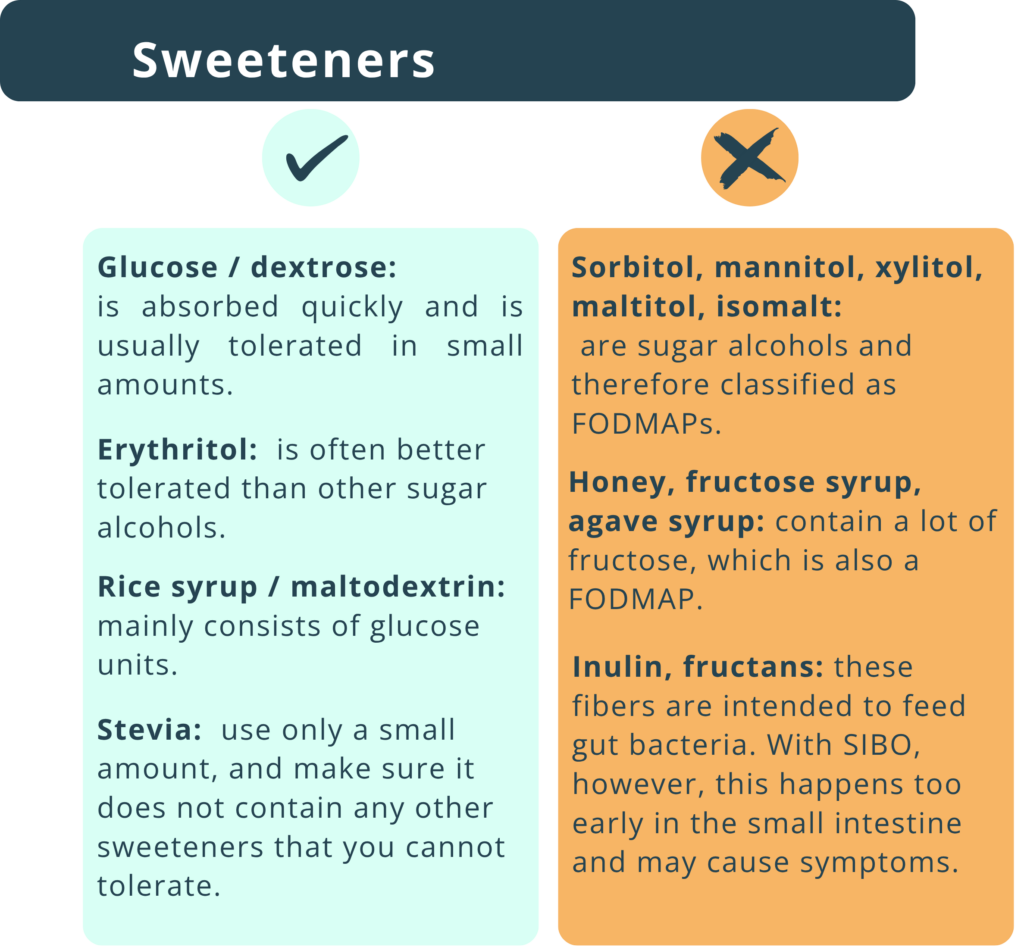
basic orientation on sweeteners for people with SIBO. Individual tolerance can vary 2,3,4
4. Are artificial sweeteners a good idea with SIBO?
Artificial sweeteners such as aspartame, sucralose, saccharin, and acesulfame K are not classified as FODMAPs. Unlike fructose or sugar alcohols, they are not fermented in the small intestine and therefore play a smaller role in SIBO from a fermentation perspective. 3
Nevertheless, studies suggest that some of these substances may affect the composition of gut bacteria and blood glucose regulation. 6,7 The evidence is not consistent, but it supports using artificial sweeteners as a temporary solution rather than as a permanent part of your diet when your goal is to strengthen long-term gut health.
If your main aim with SIBO is to reduce the burden on the small intestine, artificial sweeteners are therefore not the first choice. A generally lower-sugar diet with a small number of carefully selected sweeteners and a clear limit on the total amount is more sensible. 3,6
5. What can a reduced-sugar diet for SIBO look like?
Many SIBO recommendations suggest temporarily removing the bacteria’s “favorite food” in the small intestine. This mainly refers to certain types of sugar, white-flour products, and foods that are very high in starch. 2,3,5
Which basic rules can help in everyday life?
- Avoid sweets, sugary drinks, and highly processed convenience foods as much as possible for a few weeks, or reduce them significantly.
- Consciously reduce high-fructose fruit, conventional dairy products containing lactose, and foods containing sugar alcohols. 2,3
- Focus on protein-rich foods such as fish, eggs, meat, and tofu, as well as well-tolerated fats such as olive oil. 2,5
- Include easily digestible carbohydrate sources such as rice, cooked potatoes, or selected vegetables in manageable portions. 3
- After an initial “rest phase” for the gut, gradually test a wider variety of foods to find out what you tolerate well individually. 3
What might a SIBO-friendly breakfast look like?
- Homemade granola made from nuts and seeds, such as pumpkin seeds, sunflower seeds, and macadamia nuts, sweetened with a small amount of dextrose or erythritol. This helps keep the FODMAP load low. 2,5
- Lactose-free yogurt or a well-tolerated plant-based alternative as a source of protein.
- A small portion of low-FODMAP fruit, such as a handful of berries, as is often recommended in IBS and SIBO contexts. 3,5
6. Sugar-free cornflakes with SIBO: Are they suitable?
Many SIBO diet plans explicitly list cornflakes among the foods that should be avoided completely for several weeks. The reason is that they contain a large amount of easily digestible starch and are often additionally sweetened. 2,5
Even “sugar-free” cornflakes are not really an exception. They are made from corn starch that has been industrially processed to make it particularly easy and quick to digest. This also makes the nutrients rapidly available to bacteria in the small intestine. 2,5
Which alternatives are better suited to a SIBO diet?
- Small portions of low-FODMAP grain options such as rice flakes or selected oat alternatives, combined with plenty of nuts and seeds. 3,5
- A savory breakfast, such as eggs with well-tolerated vegetables or lactose-free dairy products, as frequently recommended in SIBO guidelines and practical dietary advice. 2,3
7. How can you sweeten foods when you have SIBO?
- Use sweetness as an “accent” rather than the main feature of a meal or drink. For example, sweeten coffee or tea with a little dextrose or stevia instead of honey or syrup. 2,3
- When baking, use nuts and seeds where possible and replace sucrose with rice syrup, maltodextrin, or erythritol. Keep in mind that the total amount of these sweeteners should also remain moderate. 2,4
- Check ingredient lists carefully. “Sugar-free” often means that a product contains sugar alcohols or inulin/fructans, which are precisely the ingredients that frequently cause problems with SIBO. 3
- Avoid heavily sweetened drinks and alcohol as much as possible, as many sources on SIBO identify them as factors that may worsen symptoms. 2,5
- Keep a food and symptom diary. This can help you recognize patterns and determine which sweeteners and amounts your body tolerates relatively well. 2,3
8. FAQ: Common questions about SIBO, sugar, and sweeteners
Is simply eating less sugar enough to improve my SIBO?
Reducing sugar and easily digestible carbohydrates is an important step because it gives the bacteria in the small intestine less food. 1,2 However, effective SIBO treatment usually involves several components, such as appropriate medical treatment, physical activity, and addressing the underlying causes.
Are “natural” sweeteners such as honey automatically better than table sugar?
Not necessarily. Honey and agave syrup contain a large amount of fructose and may cause even more symptoms than ordinary table sugar in people with sensitive digestion. This is why many SIBO and IBS programs recommend limiting them. 3,8
Can I use dextrose without making my SIBO worse?
Dextrose is absorbed quickly and is considered a small exception in some dietary plans. You can use it in moderate amounts, but you should monitor how your body responds and keep the total quantity in mind. 2
How safe are erythritol and stevia for my gut microbiome?
Studies suggest that erythritol and stevia are well tolerated compared with other sugar substitutes and do not strongly affect the gut microbiome when consumed in usual amounts. 4,6 Even so, it is advisable to introduce both gradually and pay attention to how your digestive system feels.
9. Sources
- Pimentel, M., Saad, R. J., Long, M. D., & Rao, S. S. C. (2020). ACG Clinical Guideline: Small intestinal bacterial overgrowth. American Journal of Gastroenterology, 115 (2), 165–178.
- Norddeutscher Rundfunk. (July 7, 2024). Small intestinal bacterial overgrowth: Symptoms and treatment of SIBO. NDR.de. https://www.ndr.de/ratgeber/gesundheit/Duenndarmfehlbesiedlung-Symptome-und-Behandlung-bei-SIBO,duenndarmfehlbesiedlung100.html
- Madena GmbH. (July 30, 2025). SIBO diet: What you may eat—and what you should avoid. madena.de/blogs/news/sibo-diat-was-du-essen-darfst-und-was-nicht
- NDR Health Editorial Team. (June 8, 2026). Sugar substitutes and sweeteners: Healthy or harmful? NDR.de. https://www.ndr.de/ratgeber/gesundheit/Zuckerersatz-Wie-gesund-sind-Xylit-Stevia-Erythrit,zuckerersatz108.html
- Gastropraxis Pfalz. (2024). Nutrition for SIBO—Diet plan (version 04/24). https://www.gastropraxis-pfalz.de/wp-content/uploads/2024/08/Diaetplan_SIBO_04_24.pdf
- SIBO Academy. (June 4, 2025). Sweeteners and the gut microbiome. https://sibo-academy.de/en/effects-of-sweeteners-on-the-gut-microbiome/
- MyBioma. (September 25, 2024). Sweeteners and the gut microbiome—What does the research say? mybioma.com/blogs/wissenschaft/sind-sussstoffe-und-zuckeraustauschstoffe-schlecht-fur-unser-darm-mikrobiom
- FODMAP-info.de. (June 22, 2026). Low-FODMAP sweetening is easy, but… fodmap-info.de/fodmap-suessungsmittel/