
👆 Key Takeaways
- SIBO (small intestinal bacterial overgrowth) can cause symptoms such as bloating, abdominal pain, diarrhea or constipation, and fatigue — and is often initially mistaken for irritable bowel syndrome.1,3
- Antibiotics such as rifaximin are considered standard therapy, but herbal combinations containing active compounds such as berberine, oregano oil, allicin, or neem showed comparable success rates in normalizing breath tests in one study.1,2,4
- Treatment without antibiotics is mainly based on an adapted diet (e.g., low-FODMAP phases), herbal antimicrobial preparations, and addressing underlying causes such as motility disorders or long-term PPI use — ideally under medical supervision.3,5,6
✔ Evidence-based: This article is based on medical professional sources, a clinical study on herbal preparations for SIBO, and review articles on SIBO diagnosis and treatment, including rifaximin, dietary strategies, and herbal protocols. The evidence for purely “natural” treatments without antibiotics is still limited. For this reason, herbal preparations and diets should not be understood as a substitute for proper diagnostics and medical supervision.1,2,3,4,5,6
SIBO Treatment Without Antibiotics: Natural Approaches for Small Intestinal Bacterial Overgrowth?
1. What is SIBO — and why are so many people looking for an “antibiotic-free” approach?
2. Typical symptoms and background: Why the small intestine reacts so sensitively
3. Standard antibiotic therapy: What is considered the “gold standard”?
4. Herbal alternatives: What studies show about herbal therapies
5. Diet: What role do low-FODMAP and similar approaches play?
6. Probiotics, brain fog, and D-lactic acid: Caution and opportunities
7. Treating SIBO without antibiotics — what could this look like in practice?
8. Checklist: When natural strategies make sense — and when they do not
9. FAQ: Common questions about SIBO and natural treatments
10. Sources
1. What is SIBO — and why are so many people looking for an “antibiotic-free” approach?
Many people with  SIBO (small intestinal bacterial overgrowth) know what a long road of suffering can feel like: bloating, abdominal pain, diarrhea or constipation, fullness, and fatigue are among the typical symptoms.3,6 Often, irritable bowel syndrome is diagnosed first because the symptoms are very similar and SIBO is not always considered right away.3,6
Once SIBO is finally being discussed as a diagnosis, many affected people want to know: “Do I really have to take an antibiotic?” or “Is there also a treatment without antibiotics?” — often because they have already tried many medications or are concerned about their gut flora.3,5 This article explains the role antibiotics play, which natural options are available, and where the limits of a purely herbal or diet-based treatment lie.
2. What are typical symptoms and background factors? – Why the small intestine reacts so sensitively
In SIBO, there are too many bacteria — or the “wrong” bacteria — in the small intestine, a section of the digestive tract that normally contains relatively few bacteria.1,6 These bacteria ferment food components such as carbohydrates too early and produce gases (e.g., hydrogen, methane) and other metabolic by-products that can trigger symptoms.6,8
Typical symptoms include, for example:
- a bloated abdomen, especially after eating,
- gas, pressure, and a feeling of fullness,
- abdominal pain or cramps,
- diarrhea, constipation, or alternating between the two,
- fatigue, difficulty concentrating, and sometimes weight loss.3,6
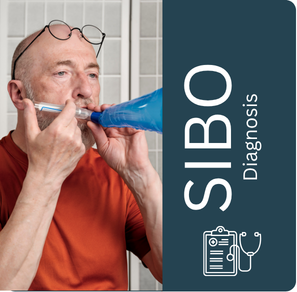
Hydrogen and methane breath tests using glucose or lactulose are often used for diagnosis.6,8 You drink a sugar solution, and the test measures whether and when gases rise in your breath — an indication that bacteria in the small intestine are “eating along” too early.

Why SIBO is often linked to IBS
Studies show that people with irritable bowel syndrome are more likely to have small intestinal bacterial overgrowth than people without an IBS diagnosis.3,6 This means that in some cases, SIBO may actually be hiding behind an IBS diagnosis — especially when bloating, gas formation, and food intolerances are particularly prominent.3
3. Standard antibiotic therapy: What is considered the “gold standard”?
Current guidelines view antibiotics as a central treatment for SIBO because they are intended to specifically reduce bacteria in the small intestine.6,7 Rifaximin is used particularly often — an antibiotic that acts mainly in the gut and is only minimally absorbed into the bloodstream.7
Many patients benefit from rifaximin, but:
- not everyone responds to treatment,
- relapses are not uncommon,
- some people prefer to avoid antibiotics on principle or because of previous experiences.1,7
This is exactly where the question arises as to whether a natural treatment — meaning one without conventional antibiotics — can be useful and effective.
4. How effective are herbal SIBO alternatives without antibiotics?
A frequently cited study by Chedid and colleagues directly compared herbal therapy with rifaximin.1,2 In this study, patients with confirmed SIBO received either rifaximin or a combination of herbal preparations containing, among other things, berberine, oregano oil, and garlic extracts (e.g., Dysbiocide, FC-Cidal).1,2
The results:
- About 46% of patients in the herbal group had a normal breath test after four weeks.
- In the rifaximin group, the figure was around 34%.
- Some patients who had not responded to rifaximin later benefited from herbal therapy.1,2
This can be summarized as follows:
- Herbal combination preparations may be similarly effective to rifaximin in selected SIBO patients.
- However, the study did not test oregano oil or berberine alone, but combinations.
- The study was not designed as rigorously as large randomized guideline-level trials, so the results must be interpreted with caution.1,3
Typical herbal active compounds
In practice, the following plant compounds are used for SIBO, among others:
- Berberine (e.g., in Candibactin-BR or barberry extracts),
 Oregano oil (carvacrol, thymol),
- Allicin (stabilized garlic extract),
- Neem (neem tree extracts).
Laboratory studies show that these substances can influence bacteria, and in some cases fungi and biofilms as well.4,5 This explains why they are used in SIBO protocols — but it does not replace large-scale, long-term research in humans.
Note on neem and berberine (Novel Food)
In the European Union, certain plant-based substances are considered so-called “novel foods”. This includes foods that were not consumed to a significant degree in the EU before May 15, 1997 and therefore must first undergo an authorization procedure before they may be placed on the market as food supplements or foods.NF1,NF2
For neem (Azadirachta indica), the EU has classified neem powder and various plant parts as unauthorized novel food. As a result, numerous neem products have been withdrawn from the market since 2024; the use of neem in food supplements is therefore heavily restricted in the EU.NF3,NF4
For berberine, the situation is more nuanced: berberine-containing plants have been used traditionally, while at the same time a Novel Food application has been submitted for isolated berberine hydrochloride and is currently being assessed by the European Food Safety Authority (EFSA). Until these assessments are completed, permissibility, dosage recommendations, and labeling requirements may change.NF5
For consumers, this means that the legal availability of neem and berberine products can change at short notice. Such preparations should only be used after professional advice, and it is sensible to choose products that comply with the currently applicable Novel Food requirements in the EU. Quality and standardization are particularly important for herbal products. Because the market for herbal preparations is not tightly regulated, only products whose active compound concentration (e.g., standardized berberine extract) has been laboratory-tested should be used to help ensure consistent efficacy.
5. Diet: What role do low-FODMAP and similar approaches play?
Diet is a central component of SIBO therapy. Bacteria in the small intestine “live” on what you eat — especially on carbohydrates that can be easily fermented.3,6 One well-known strategy is the low-FODMAP diet: for a limited period, certain sugars and fibers that are highly fermentable are reduced (e.g., in wheat, onions, garlic, and certain fruits).3,8
The goal:
- less “food” for the bacteria,
- less gas production and bloating,
- less pain and diarrhea.
Important:
- The low-FODMAP diet is a short-term measure intended to reduce symptoms.
- Ideally, it should be supervised by a nutrition professional to avoid nutritional deficiencies.
- It can relieve symptoms, but on its own it is usually not enough to permanently eliminate an existing overgrowth.3,6
After the intensive phase, the aim is to gradually reintroduce foods and find a long-term tolerable diet that takes both symptoms and the gut flora into account.
6. Probiotics, brain fog, and D-lactic acid: Caution and opportunities
Some people with SIBO report a “foggy” head (“brain fog”), difficulty concentrating, or feelings of drowsiness — often worse after eating.3 One study described a link between SIBO, certain probiotics, D-lactate-producing bacteria, and so-called D-lactic acidosis; symptoms improved after probiotics were discontinued and the overgrowth was treated.5
On the other hand, other studies show that selected probiotics may improve intestinal motility or reduce SIBO risks associated with certain medications (e.g., PPIs).3,5
In practice, this means:
- probiotics are not generally forbidden in SIBO,
- but they should be used in a targeted and strain-specific way,
- special caution is needed in cases of brain fog or D-lactate problems.
Postbiotics (e.g., inactivated bacteria or their metabolic products) are considered a possible way to use beneficial effects on the gut barrier and immune system without introducing live bacteria — but research in this area is still at an early stage.5
7. Treating SIBO without antibiotics — what could this look like in practice?
A purely “antibiotic-free” treatment is not useful or possible in every case, but it may be considered for selected patients — especially when:
- symptoms are mild to moderate,
- there are no serious underlying diseases,
- proper diagnostics have already been completed.
A possible practical approach could look like this:
- Confirm the diagnosis: breath test (H2/CH4), medical examination, and if necessary additional tests to rule out other causes.6,8
- Adjust the diet: a time-limited low-FODMAP phase or an individually adapted reduction of fermentable carbohydrates, followed by gradual expansion.3
- Use herbal preparations: for example berberine- and oregano-oil-containing combinations, adjusted to the SIBO type and individual tolerability, usually over 4–6 weeks.1,4
- Support gut motility: movement and, where appropriate, prokinetic strategies (medicinal or herbal) according to medical advice.3,5
- Address causes: for example, critically review long-term PPI use, and treat anatomical abnormalities or metabolic diseases.3,6
It is important not to regard herbal therapies as “harmless”: they have effects and can cause side effects — so they should be taken just as seriously as medications.
8. Checklist: When natural strategies make sense — and when they do not
| Situation | Natural strategies without antibiotics | Assessment |
|---|---|---|
| Confirmed SIBO, rather mild to moderate symptoms | Diet + herbal combination preparations + motility support. | Can be a reasonable option when the diagnosis is clear and therapy is medically supervised. The evidence comes mainly from studies on herbal protocols.1,3 |
| Rifaximin non-responders | Switch to berberine-/oregano-containing herbal combinations. | In the Chedid study, some non-responders benefited from herbal therapy. The decision should be made individually and with careful risk assessment.1,2 |
| Severe symptoms, weight loss, blood in the stool, fever | Diet and herbs. | Not recommended. In such cases, prompt medical evaluation and often guideline-based treatment, including antibiotics, are necessary.6,7 |
| Recurring SIBO after successful treatment | Natural relapse-prevention strategies (diet, herbal prokinetics, possibly short herbal cycles). | May be useful for stabilizing the small intestine long term. It is important to address underlying causes (e.g., PPIs, motility disorders).3,5 |
9. FAQ: Common questions about SIBO and natural treatments
Can SIBO be treated purely naturally — completely without antibiotics?
In some cases, combinations of diet, herbal preparations, and measures to improve gut motility can be an alternative or complement to antibiotics.1,3 Whether this makes sense depends on severity, underlying conditions, and individual risks — there is no blanket recommendation.
Is a low-FODMAP diet enough to cure SIBO?
A low-FODMAP diet can significantly relieve symptoms such as bloating, pain, and diarrhea because it reduces the “food” available to bacteria.3,6 According to current knowledge, however, it usually does not replace targeted antimicrobial treatment, but is an important component of an overall strategy.
Are herbal preparations automatically safer than antibiotics?
“Natural” does not automatically mean “harmless.” Herbal antimicrobials such as berberine, oregano oil, or allicin can have strong effects and may cause side effects or interact with other medications.4,5 They should therefore be treated like medicines and not used without guidance.
Why does SIBO often come back after natural treatment?
Relapses are common when the underlying causes — such as motility disorders, anatomical abnormalities, or long-term PPI therapy — remain in place.3,6 That is why it is important not only to treat the bacteria, but also to work long term on diet, movement, medications, and other influencing factors.
When should I definitely seek medical help?
If you have severe pain, fever, unintended weight loss, blood in the stool, or nighttime symptoms, you should definitely seek medical evaluation.6 Even with long-lasting symptoms and no clear diagnosis, specialist medical assessment is more important than self-treatment alone.
10. Sources
- Chedid V, Dhalla S, Clarke JO, et al. Herbal therapy is equivalent to rifaximin for the treatment of small intestinal bacterial overgrowth. Glob Adv Health Med. 2014;3(3):16–24. PMID: 24891990; PMC4030608.[Link]
- Herbal Therapy Is Equivalent to Rifaximin for the Treatment of Small Intestinal Bacterial Overgrowth — full-text analysis via PubMed/PMC, including information on success rates and non-responder strategies.[Link]
- Pimentel M, Saad RJ, Long MD, Rao SSC. ACG Clinical Guideline: Small Intestinal Bacterial Overgrowth. Am J Gastroenterol. 2020;115(2):165–178. Guideline overview on diagnostics, breath tests, causes, and treatment options.[Link]
- Metagenics UK. How Effective Is Natural Treatment For SIBO? Online article discussing herbal therapies (including berberine, oregano, garlic) compared with rifaximin, based on the Chedid study.[Link]
- Rao SSC et al. Brain fogginess, gas and bloating: a link between SIBO, probiotics and D-lactic acidosis. Scientific article on possible links between SIBO, probiotics, and neurological symptoms, as well as critical commentary.[Commentary at ISAPP: Link]
- NHS / clinical protocols on the management and antibiotic treatment of SIBO (including metronidazole and rifaximin), based on ACG guidelines and other evidence-based recommendations.[Link]
- Gatta L, Scarpignato C. Systematic review with meta-analysis: Rifaximin is effective and safe for the treatment of small intestinal bacterial overgrowth. Aliment Pharmacol Ther. 2017;45(5):604–616. Meta-analysis on the efficacy and safety of rifaximin in SIBO.[Link]
- Rezaie A, Buresi M, Lembo A, et al. Hydrogen and Methane-Based Breath Testing in Gastrointestinal Disorders: The North American Consensus. Am J Gastroenterol. 2017;112:775–784. Consensus paper on breath tests (H2/CH4) for SIBO and other GI disorders.[Link]