
👆 Das Wichtigste in Kürze
- The gut microbiome is essential for our health – a diverse microbiome is central for our mental and physical well-being.
- Our diet directly influences our gut microbiome, which is why a varied diet is so important.
- But other lifestyle factors such as regular relaxation, physical activity, and good sleep hygiene, also play a key role in sustainably stabilizing the microbiome.
Boost Your Gut Microbiome: Tips to Restore Gut Balance
Content
1. Gut Health
2. What is the gut microbiome?
2.1 Why is the gut microbiome important?
3. How can you strengthen your gut microbiome?
3.1 Dietary fibers
3.1.1 Different kinds of dietary fibers
3.1.2 Sources for dietary fibers
3.1.3 Recommended fiber intake
3.1.4 Everyday tips
3.2 Fermented foods
3.3 Variety of foods
3.4 Reducing stress and improving sleep
4. Summary
1. Gut Health
Our gut is more than just a digestive organ – it is home to trillions of microorganisms that together form the gut microbiome. These microscopic residents have a huge impact on our health: they aid digestion, strengthen the immune system, and even influence our mental well-being. But how can you deliberately build and strengthen your gut microbiome?
2. What is the gut microbiome?
The gut microbiome refers to the totality of all microorganisms in the gut, mainly bacteria, but also fungi and viruses. A healthy microbiome is diverse – the more different beneficial bacterial strains, the more stable the balance. An imbalance, also known as dysbiosis, can, on the other hand, be associated with numerous issues, such as bloating, increased susceptibility to infections, or chronic inflammation.
2.1 Why is the gut microbiome important?
Research in recent years has shown clearly that a stable gut microbiome is crucial for our health. It
- regulates the immune system (about 70–80% of all immune cells are located in the gut) (1,2),
- produces vitamins (e.g., vitamin K and B12) (3),
- influences mood through the so-called gut-brain axis (4),
- protects against pathogens (competing for colonization sites),
- and aids the digestion of complex food components (5).
3. How can you strengthen your gut microbiome?
3.1 Dietary fibers
For a long time, dietary fiber was considered “indigestible plant residue,” but today we know that it is essential for a healthy gut microbiome. Fiber consists of special carbohydrates that pass undigested into the large intestine, where they serve as food for beneficial gut bacteria.
3.1.1 Different kinds of dietary fibers
How well fiber is broken down in the gut depends on its characteristics: the key factors are primarily its solubility in water and its viscosity – that is, how “thick” it becomes in the gut (5):
- Soluble, non-viscous fibers such as inulin (e.g., from chicory or onions) are particularly easy for our gut bacteria to digest. They are almost completely fermented, meaning they are broken down and converted into beneficial substances such as short-chain fatty acids (SCFAs) like butyrate, acetate, and propionate. These substances have anti-inflammatory properties, strengthen the gut barrier, and even serve as an energy source for the cells of the intestinal lining.
- Soluble, viscous fibers such as psyllium swell in the gut and form a gel-like substance. They are fermented more slowly and often only partially.
- Insoluble fibers such as cellulose (e.g., from whole grains or vegetable peels) mostly pass through the gut undigested. They serve less as a nutrient source and more as “bulk.” They stimulate intestinal movement, increase stool volume, and thereby promote regular digestion. Sources include wheat bran, whole grains, and vegetable peels.
3.1.2 Sources for dietary fibers
Fiber is found almost exclusively in plant-based foods. Various vegetables, especially legumes, are particularly rich in these important fibers. These include, among others, salsify, artichokes, soybeans, and chickpeas. Nuts and seeds are also good sources of fiber. Ground flaxseeds are especially noteworthy, as they contain about 22 grams of fiber per 100 grams, making them a top source. (6)
Another important source is whole grains. Products such as whole-grain bread, whole-grain pasta, or bran contain significantly more fiber than their refined counterparts. For comparison: 100 grams of cooked whole-grain pasta provide about 5 grams of fiber, while regular white pasta made from durum wheat contains only around 2 grams. (6)
Many types of vegetables, mushrooms, and fruits also contribute to fiber intake. Good examples include onions, garlic, leeks, bell peppers, carrots, broccoli, asparagus, artichokes, rhubarb, porcini and chanterelle mushrooms, as well as berries and pears. (6)
A colorful, varied diet with plenty of vegetables, whole grains, and legumes makes it easy to consume enough fiber.
3.1.3 Recommended fiber intake
The German Nutrition Society (DGE) recommends a minimum of 30 grams of fiber per day (7).
However, most people only reach about 15 to 20 grams per day. Even a small dietary change can make a big difference.
3.1.4 Everyday tips
Increase gradually: Those who have previously eaten a low-fiber diet should raise their intake step by step; otherwise, bloating or a feeling of fullness may occur.
Drink enough fluids: Fiber needs water to swell properly in the gut.
Choose whole grains instead of refined flour: Simply switching from white bread to whole-grain bread adds several grams of fiber to your daily intake.
Combine raw and cooked vegetables: Both contain different types of fiber that have distinct effects on digestion.
3.2 Fermented foods
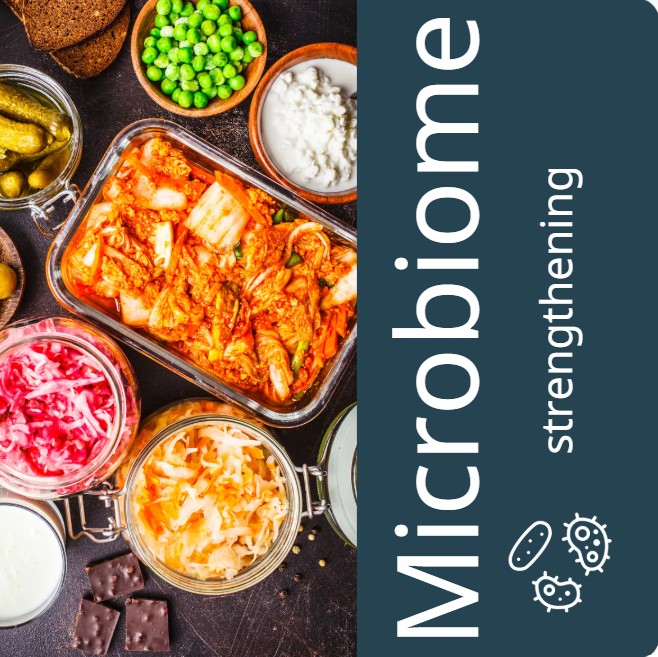
Fermented foods are usually traditional products in which microorganisms (mostly lactic acid bacteria or yeasts) convert carbohydrates into acids or gases. This process not only creates characteristic flavors and extends shelf life but also provides health benefits. Many fermented foods contain live probiotic cultures that, when consumed, supply beneficial bacteria to the gut and positively influence the microbiome. Additionally, fermented products contain microbial metabolites (substances produced by bacteria during fermentation), which can also have health-promoting effects. (8)
Typical examples include yogurt, kefir, raw (unpasteurized) sauerkraut, kimchi, miso, tempeh, natto, and kombucha. It is important to note that not all supermarket products still contain live microorganisms, as many are pasteurized. For a probiotic effect, fermented foods should be unpasteurized and consumed as fresh as possible.
3.2.1 Key Effects of Fermented Foods
- Promotion of Microbiome Diversity and Stability:
Regular consumption of fermented foods (e.g., yogurt, kefir, sauerkraut, kimchi, kombucha) can increase bacterial diversity in the gut. A diverse microbiome provides better protection against harmful pathogens and contributes to long-term gut health. - Immune System Support and Anti-Inflammatory Effects:
A healthy gut is closely linked to a strong immune system. Fermented foods can enhance immune responses and exhibit anti-inflammatory effects. (9) - Complete Package for Gut Health:
Fermented foods provide probiotics (live bacteria), prebiotics (food for the bacteria), and postbiotics (metabolic byproducts with health
Regular consumption of fermented foods is therefore one of the most effective ways to strengthen the gut microbiome and promote long-term gut health.
3.3 Variety of foods
As a rule of thumb: the more varied the diet, the more diverse the microbiome (10). A plant-based diet rich in vegetables, legumes, whole grains, nuts, and seeds is especially recommended. People who consume more than 30 different plant-based foods per week have a significantly higher microbial diversity in their gut.
3.4 Reducing stress and improving sleep
Chronic stress and lack of sleep affect not only the nerves but also the gut. This is due to the close connection between the brain and the digestive system, known as the gut-brain axis. Prolonged stress can reduce the diversity of gut bacteria while potentially harmful microbes may increase. This creates an imbalance that has been linked to digestive problems, inflammation, and even mood swings.
Insufficient or poor-quality sleep also affects the gut microbiome. During sleep, important regenerative processes take place in the gut. Regularly getting too little sleep disrupts this natural rhythm.
Scientific studies show that even just a few nights of disturbed or reduced sleep can measurably alter the composition of gut flora. For example, a placebo-controlled study in healthy adults demonstrated that after only two nights of severely restricted sleep (just 2 hours per night), microbial diversity in the gut decreased significantly (11). The relative abundance of certain bacterial groups also changed following short-term sleep restriction. (12,13)
It is therefore important to allow both body and mind to rest, as this not only strengthens the nervous system but also creates the best conditions in the gut for a healthy and resilient microbiome. Helpful tips and exercises include, for example:
- Mindfulness and meditation: just a few minutes daily can help reduce stress hormone levels.
- Moderate outdoor exercise: improves blood circulation and has a balancing effect.
- Digital detox before bedtime: supports a natural day-night rhythm.
- Consistent sleep schedule and a dark, quiet bedroom: for deep, restorative sleep.
4. Summary
A healthy gut microbiome is a central pillar of both physical and mental well-being. It can be specifically strengthened through a fiber-rich, diverse, and predominantly plant-based diet, regular consumption of fermented foods, sufficient sleep, and mindful stress management. These measures promote microbial diversity in the gut, support immune function, regulate inflammatory processes, and thereby make a valuable contribution to long-term health maintenance.
5. FAQs
What is the role of the gut micorbiome for our health?
Our gut, home to trillions of microorganisms that together form the so-called gut microbiome, plays a major role in our health. These microscopic companions have an enormous impact: they support digestion, strengthen the immune system, and are even connected to our mental well-being.
How can we influence our microbiome?
A diet rich in fiber and fermented foods, combined with stress management and good sleep, forms the foundation for a strong gut microbiome and long-term health.
What are good sources of fibre?
Fiber is found mainly in plant-based foods: various vegetables, legumes, nuts, and seeds are good sources. Whole grains, mushrooms, and fruits are also rich in fiber.
References
- https://www.rosenfluh.ch/media/arsmedici/2014/04/Darm_und_Immunsystem.pdf; Darm und Immunsystem – Abwehr aus dem Bauch heraus; S.C. Bischoff und S. Meuer; last checked 03.08.2025
- Hooper, L.V., Littman, D.R., and Macpherson, A.J. (2012). Interactions between the microbiota and the immune system. Science (New York, N.Y.) 336, 1268-1273. https://doi.org/10.1126/science.1223490.
- LeBlanc JG, Milani C, de Giori GS, Sesma F, van Sinderen D, Ventura M. Bacteria as vitamin suppliers to their host: a gut microbiota perspective. Curr Opin Biotechnol. 2013 Apr;24(2):160-8. doi: 10.1016/j.copbio.2012.08.005 . Epub 2012 Aug 30. PMID: 22940212.
- Socała K, Doboszewska U, Szopa A, Serefko A, Włodarczyk M, Zielińska A, Poleszak E, Fichna J, Wlaź P. The role of microbiota-gut-brain axis in neuropsychiatric and neurological disorders. Pharmacol Res. 2021 Oct;172:105840. doi: 10.1016/j.phrs.2021.105840. Epub 2021 Aug 24. PMID: 34450312.
- Le Feunteun S, Al-Razaz A, Dekker M, George E, Laroche B, van Aken G. Physiologically Based Modeling of Food Digestion and Intestinal Microbiota: State of the Art and Future Challenges. An INFOGEST Review. Annu Rev Food Sci Technol. 2021 Mar 25;12:149-167. doi: 10.1146/annurev-food-070620-124140. Epub 2021 Jan 5. PMID: 33400557.
- https://www.dge.de/gesunde-ernaehrung/faq/ausgewaehlte-fragen-und-antworten-zu-ballaststoffen/#c3558; Ausgewählte Fragen und Antworten zu Ballaststoffen; DGE; last checked 03.08.2025
- https://www.dge.de/wissenschaft/referenzwerte/ballaststoffe/; Ballaststoffe; DGE; last checked 03.08.2025
- Leeuwendaal NK, Stanton C, O’Toole PW, Beresford TP. Fermented Foods, Health and the Gut Microbiome. Nutrients. 2022 Apr 6;14(7):1527. doi: 10.3390/nu14071527. PMID: 35406140
- Schoen C, Schulz A, Schweikart J, Schütt S, von Baehr V. Regulatory effects of a fermented food concentrate on immune function parameters in healthy volunteers. Nutrition. 2009 May;25(5):499-505. doi: 10.1016/j.nut.2008.10.022. Epub 2009 Jan 3. PMID: 19121921.
- Heiman ML, Greenway FL. A healthy gastrointestinal microbiome is dependent on dietary diversity. Mol Metab. 2016 Mar 5;5(5):317-320. doi: 10.1016/j.molmet.2016.02.005. PMID: 27110483; PMCID: PMC4837298. Titel anhand dieser PMC-ID in Citavi-Projekt übernehmen
- Benedict C, Vogel H, Jonas W, Woting A, Blaut M, Schürmann A, Cedernaes J. Gut microbiota and glucometabolic alterations in response to recurrent partial sleep deprivation in normal-weight young individuals. Mol Metab. 2016 Oct 24;5(12):1175-1186. doi: 10.1016/j.molmet.2016.10.003. PMID: 27900260; PMCID: PMC5123208.
- Karl JP, Whitney CC, Wilson MA, Fagnant HS, Radcliffe PN, Chakraborty N, Campbell R, Hoke A, Gautam A, Hammamieh R, Smith TJ. Severe, short-term sleep restriction reduces gut microbiota community richness but does not alter intestinal permeability in healthy young men. Sci Rep. 2023 Jan 5;13(1):213. doi: 10.1038/s41598-023-27463-0; PMCID: PMC9816096.
- https://www.gutmicrobiotaforhealth.com/sleep-loss-may-impact-gut-microbiota-healthy-young-normal-weight-individuals/; Sleep loss may impact the gut microbiota in healthy, young normal-weight individuals; last checked 03.08.2025